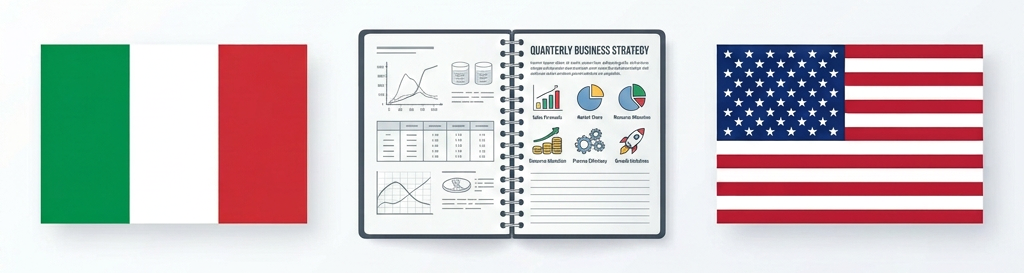
TWO COUNTRIES.
TWO LANGUAGES.
ONE QUESTION.
How does culture, language, and education influence the way we understand money, risk, and opportunity?
Money Without Borders brings together reflective perspectives and accessible guides to reading financial literacy research for high school students in Italy and the United States. A place to ask thoughtful questions—and consider a different point of view.
Latest writing
Why I'm Asking
I was born and raised in Italy and have spent my entire life in the Italian public school system. I am currently a student at Liceo Scientifico Poliziano in Montepulciano Tuscany Italy. But at home, my experience has always been a little different. My mother is American and my father is Italian, so I grew up speaking both English and Italian from birth. I consider both languages my mother tongues, and I have always been interested in how language and culture shape the way we see the world.
As I have grown older, I have become particularly curious about how education shapes what happens after high school. The Italian and American education systems are structured very differently, and I have often wondered why. Do students in the two countries learn different skills? Are they encouraged to think about careers, entrepreneurship, money and risk in different ways? And do those differences ultimately affect the opportunities people have later in life?
My interest in these questions grew during the summer of 2026, when I took courses in economics and business formation and entrepreneurship. I became fascinated by the idea that what young people learn—or don't learn—about money, business and economic decision-making can influence the choices they make later in life. I also have worked a summer job in America the last three summers and compare that to experiences of people my age in Italy in wanting to work in the summer months.
I am particularly interested in public policy and linguistics, and I want to explore the connection between language, education, culture and economic opportunity. I also want to understand whether growing up speaking more than one language can create different opportunities, particularly in an increasingly international economy.
I hope to attend university in the United States after graduating from high school, which gives me a personal reason to look more closely at both systems. Rather than trying to decide which country has the "better" education system, I want to understand why they are different, what each system does well, what it could improve, and how those differences might shape students' futures.
Over the next three years, I plan to explore these questions through interviews and surveys with students, teachers, entrepreneurs and other professionals; reading research and articles; participating in organizations and projects related to financial literacy and public policy; and learning from people with experience in both countries.
This blog is a place for me to document what I discover.
I don't expect to have all the answers. In fact, the questions are what interest me most.
How much does where we grow up shape what we believe is possible?
Why I'm Asking
I was born and raised in Italy and have spent my entire life in the Italian public school system. I am currently a student at Liceo Scientifico Poliziano in Montepulciano Tuscany Italy. But at home, my experience has always been a little different. My mother is American and my father is Italian, so I grew up speaking both English and Italian from birth. I consider both languages my mother tongues, and I have always been interested in how language and culture shape the way we see the world.
As I have grown older, I have become particularly curious about how education shapes what happens after high school. The Italian and American education systems are structured very differently, and I have often wondered why. Do students in the two countries learn different skills? Are they encouraged to think about careers, entrepreneurship, money and risk in different ways? And do those differences ultimately affect the opportunities people have later in life?
My interest in these questions grew during the summer of 2026, when I took courses in economics and business formation and entrepreneurship. I became fascinated by the idea that what young people learn—or don't learn—about money, business and economic decision-making can influence the choices they make later in life. I also have worked a summer job in America the last three summers and compare that to experiences of people my age in Italy in wanting to work in the summer months.
I am particularly interested in public policy and linguistics, and I want to explore the connection between language, education, culture and economic opportunity. I also want to understand whether growing up speaking more than one language can create different opportunities, particularly in an increasingly international economy.
I hope to attend university in the United States after graduating from high school, which gives me a personal reason to look more closely at both systems. Rather than trying to decide which country has the "better" education system, I want to understand why they are different, what each system does well, what it could improve, and how those differences might shape students' futures.
Over the next three years, I plan to explore these questions through interviews and surveys with students, teachers, entrepreneurs and other professionals; reading research and articles; participating in organizations and projects related to financial literacy and public policy; and learning from people with experience in both countries.
This blog is a place for me to document what I discover.
I don't expect to have all the answers. In fact, the questions are what interest me most.
How much does where we grow up shape what we believe is possible?
Three lenses on financial literacy
Culture
Consider how family conversations and everyday experiences can influence our ideas about saving, spending, and risk.
Language
Look at the words we use for money—and the assumptions that can get lost when ideas cross languages.
Education
Ask how people learn about money, what learning measures capture, and which questions deserve a closer look.